 Come on, admit it. If you are like the rest of us, you have, at some point in time, indulged in wishful thinking about what to ask for if a genie appeared to grant three wishes with no limitations. So, what if Aladdin did actually appear from out of his bottle promising to fulfill three recruitment-related wishes, unencumbered by the dreary realities of limited resources or an ever-shrinking budget? What would you wish for?
That’s the answer we were seeking when we recently had some fun with our 2014 Recruiting Innovations and Best Practices Survey (conducted with technical assistance from the Center for Research and Service at Illinois Institute of Technology, email me for the report).
We asked respondents “If you had unlimited resources and dollars to invest, what would you invest in over the next 12 months?” (BTW: Susan Collins from Talbots is going to talk about something similar at the San Diego ERE event; Talbots has a $25,000 pot of experimental money.) We encouraged survey takers to answer the question in the context of their:
- Recruitment strategies
- Technology/tools
- Processes
- And, finally, the people within their recruitment organization.
For each of the above topical areas, respondents had free rein to write in their answers. On the topic of strategy, the wishes ranged widely, from campus recruitment programs to retention efforts, and from training for hiring managers to major overhauls of existing technology.
In a couple of instances, the technology/tools asked for don’t even (to the best of our knowledge) yet exist — witness the person who wished for “a tool that will provide better business intelligence on how we can recruit and hire employees that will partner well with our clients. Something better than a CRM or Salesforce.”
And another who would, unimpeded by budget or resources, invest in “the ultimate system/technology/tool that does it ALL (a HRMS that identifies, assess competence level , compares, tracks & reports) including effort reporting; it would communicate with other HRIS, ATS, CRM, SEO & SEM systems.”
Despite these generally varied responses, the one major common thread within this “wish list” of responses is measurement, particularly in terms of capturing, analyzing, and using data to drive informed decisions to improve. Here are some excerpts from the write-in comments:
- “Use same tools being used to recruit top talent to ensure development of existing human capital as a valued asset [from which to recruit to fill open jobs] in the company”
- “Conducting “post hire” interviews with new hires after 60 days to determine how well things are going and see if there is anything that we can do to make their onboarding experience better (and intervene if there are issues beginning to surface). Also get their input on the recruiting and new hire orientation processes and remind them about our employee referral program.”
- “I am very interested in what motivates people; why do they come to work. I would like to work with a researcher in this area and design and implement a large-scale survey among the demographic we recruit for our jobs.”
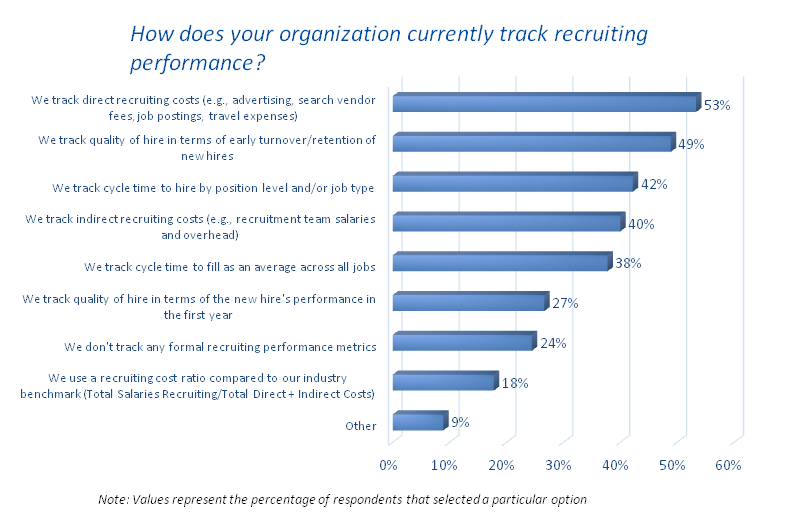
It makes sense that recruitment and HR leaders want more metrics and measurement. After all, that’s how we chart our progress on how well we add value to our organizations and how we ultimately gain and keep our seats at the strategy table. So, the themes of metrics and measurement aren’t a surprise. What is somewhat disheartening, however, is that so many organizations still have metrics on their wish lists as opposed to having implemented them; nearly a quarter (24 percent) of the survey respondents in a separate question said that they don’t track any formal recruiting metrics. (See the chart above, click to enlarge).
Measurement shouldn’t be a pipedream. It’s time to make it a reality, if you haven’t already done so. A final word of caution however. Making decisions on the basis of pure data gleaned from metrics you do track, without context, can lead you down a path of bad business decisions.
